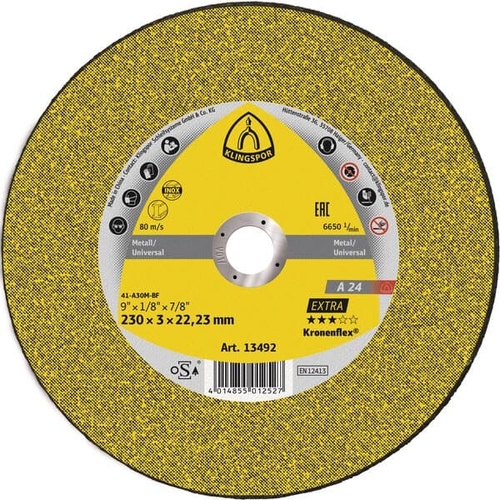

Metal Cutting Discs for Angle Grinders
Oz Abrasives supplies metal cutting discs and cut-off wheels for angle grinders in a range of diameters, thicknesses and product specifications. The range includes thin and standard cutting discs for steel, stainless steel and other specified materials, with common sizes including 100mm, 115mm, 125mm, 180mm and 230mm. Choose a disc based on the material, disc diameter, bore, thickness, disc type and the grinder's rated speed.
How to Choose a Cutting Disc
Start with the material you are cutting, then select the correct disc diameter and bore for the grinder. Next, choose the disc thickness and product type for the job. Thin discs are commonly selected where a narrow kerf and faster cutting are required; thicker discs can be appropriate where the product specification calls for additional rigidity or durability. Always follow the individual disc and tool manufacturer's instructions.
Cutting Disc Thickness Guide
The current Oz range includes 1.0mm, 1.6mm, 2.0mm and 2.5mm-class products, depending on diameter and product. AIMS' current cutting-disc guide similarly positions 1.0–1.6mm discs for fast, clean cutting on sheet, tube and smaller sections and 2.0–3.0mm discs for heavier sections, while stressing that selection depends on the application. Use the individual product specification rather than treating one thickness as universally correct.
Cutting Discs for Steel and Stainless Steel
Oz Abrasives lists products specifically for steel and stainless steel, including INOX products. For stainless steel, select a disc explicitly rated for stainless steel/INOX to avoid using an unsuitable product. Product specifications should determine the approved material range.
Flat vs Depressed-Centre Cutting Discs
The catalogue includes flat cutting discs and depressed-centre products. Choose the disc profile and mounting arrangement specified for the tool and application. Do not assume flat and depressed-centre products are interchangeable without checking the product and grinder instructions.
Cutting Disc Sizes
Common sizes in the current catalogue include 100mm, 115mm, 125mm, 180mm and 230mm. Match the diameter and bore to the grinder and use only a disc whose maximum rated speed is compatible with the tool.
Cutting Disc Applications
The range is positioned for metal fabrication, workshop cutting and professional applications. Products are available for steel, stainless steel and selected non-ferrous or other materials where the individual product specification supports the application.
Cutting Disc vs Grinding Disc
A cutting disc is designed for parting/cutting operations, while a grinding disc is designed for grinding and stock removal. Do not use a cutting disc as a grinding disc or apply lateral/side loading unless the product is specifically designed and rated for that operation. Select the correct abrasive product for the task.
Why Buy Cutting Discs from Oz Abrasives?
Oz Abrasives offers an industrial cutting-disc range across multiple sizes, thicknesses, brands and material-specific options. Customers can filter and compare products and then use the individual technical specifications to select the appropriate disc for the job.
Frequently Asked Questions
What is a cutting disc used for?
Cutting discs are abrasive wheels designed for parting cuts through materials covered by the product specification, including steel and stainless steel products in the Oz range.
What size cutting disc do I need?
Match the disc diameter and bore to your angle grinder and the product specification. Oz Abrasives currently lists common diameters including 100mm, 115mm, 125mm, 180mm and 230mm.
What thickness cutting disc should I use?
Choose thickness based on the material, section size and product recommendation. Oz Abrasives lists thin and standard options including approximately 1.0mm, 1.6mm, 2.0mm and 2.5mm products.
What is the difference between a 1mm and 1.6mm cutting disc?
Thickness changes the cutting characteristics and suitability for different jobs. Thin discs can provide a narrower kerf and fast cutting, while thicker discs may offer more rigidity. Check the product specification for the intended use.
Can I use a cutting disc on stainless steel?
Yes, where the specific disc is rated for stainless steel/INOX. Choose a product whose specification explicitly confirms stainless-steel suitability.
Can I use a metal cutting disc on aluminium?
Only use a product whose specification confirms aluminium/non-ferrous suitability. Do not assume a general steel cutting disc is suitable for aluminium.
What is an INOX cutting disc?
INOX is a common designation for stainless-steel cutting products. Use the product specification to confirm the exact material rating and formulation.
What is the difference between a cutting disc and grinding disc?
Cutting discs are designed for parting cuts, while grinding discs are designed for surface grinding and stock removal. Use each product only for its specified operation.
Can I use a cutting disc sideways?
Do not side-load or grind with a cutting disc unless the specific product is explicitly designed and rated for that operation. Follow the manufacturer's instructions.
What RPM should a cutting disc have?
Every disc has a maximum operating speed. The grinder's operating speed must not exceed the disc's rated maximum. Check the markings on the disc and the tool before use.